
Metadata standards
LIDO
LIDO 1.1 is the base schema. Minimaldatensatz (minimum data set), DDB-LIDO and EODEM are profiles on top of it and share paths and concepts.
The requirement levels in the tables are those of the base schema. The profiles can deviate from them at individual nodes, and EODEM uses its own selection. The administration shows on each node which level applies in the chosen profile.
In the base schema, object type, classification, title, inventory number, material, technique and subject keyword are repeatable. The structured concepts dimensions, event and media file take any number of entries anyway.
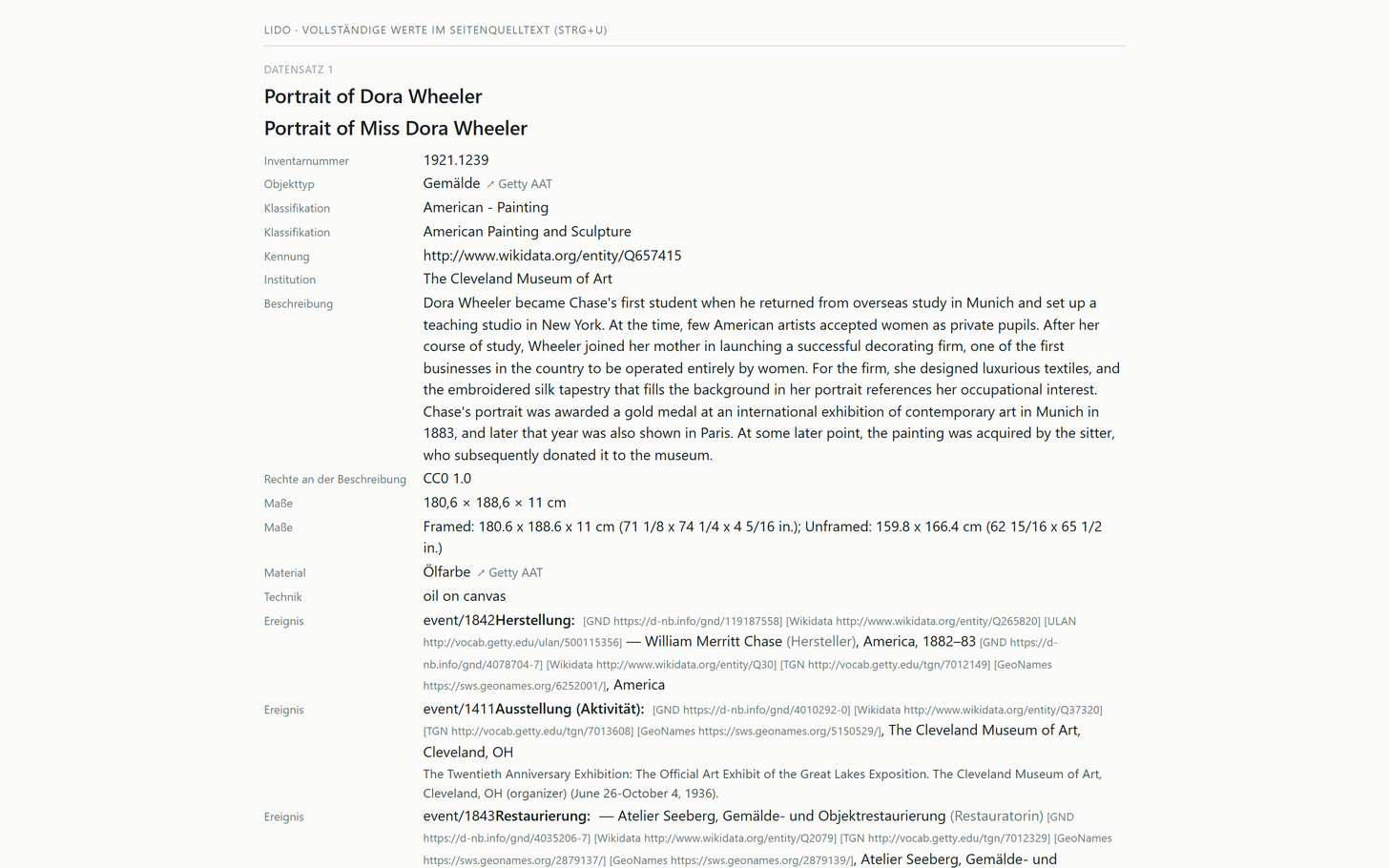
Classification
| Node | Concept | Level | Value kind |
|---|---|---|---|
| Object type / name | objectType | Mandatory | Authority record, with language |
| Classification | classification | Recommended | Authority record, with language |
| Object category (CIDOC CRM) | objectCategory | Optional | Authority record, with language |
Identification and description
| Node | Concept | Level | Value kind |
|---|---|---|---|
| Object title / name | title | Mandatory | Text, with language |
| Inventory number | inventoryNumber | Mandatory | Text |
| Holding institution | holdingInstitution | Mandatory | Text, with language |
| Holding institution ID | holdingInstitutionID | Recommended | Text (ISIL or GND) |
| Object description | description | Recommended | Text, with language |
| Source of the description | descriptionSource | Optional | Text, with language |
| Rights in the description | descriptionRights | Recommended | Authority record, with language |
| Inscriptions / marks | inscriptions | Optional | Text |
| Description of the inscription | inscriptionNote | Optional | Text, with language |
| Distinguishing features | distinguishingFeatures | Optional | Text, with language |
| Print state | objectState | Optional | Text, with language |
| Edition | edition | Optional | Text, with language |
Material and technique
| Node | Concept | Level | Value kind |
|---|---|---|---|
| Material | material | Recommended | Authority record, with language |
| Technique | technique | Recommended | Authority record, with language |
| Material/technique (display) | materialsTechDisplay | Recommended | Text, with language |
Dimensions
| Node | Concept | Level | Value kind |
|---|---|---|---|
| Dimensions | measurement | Recommended | structured |
measurement has nine facets: extent, type, value, unit, display, qualifier, format, shape and scale. A JSON field with extent, type, value and unit supplies it in
one go. Individual fields work as well.
Event
| Node | Concept | Level | Value kind |
|---|---|---|---|
| Event (object history) | event | Mandatory | structured |
The facets of event:
| Facet | Meaning |
|---|---|
eventType | Event type (LIDO terminology) |
displayEvent | Summary as text |
roleInEvent | Role of the object in the event |
eventName | Name or title of the event |
actor, actorID | Person or corporate body, with identifier |
actorRole | Role of the person or corporate body |
date | Date |
place, placeID | Place, with identifier |
culture | Culture |
periodName | Period or epoch |
method | Method |
materialsTech | Material and technique |
attributionQualifier | Attribution |
measurement | Measurement on the event: type, unit, value |
note | Note with a type: type, value |
These two facets do not fix a list; they carry entries with a type you can choose freely. An insurance value for EODEM is a measurement entry of type insurance value with unit EUR. Handling, climate and hazardous substances are note entries of the types handling, environment and hazard.
That is why EODEM needs no fields of its own in the hub, only entries with the right types.
If event has the source Events of the object, all maintained events go into the export. You can restrict this by limiting it to event types,
for example to herstellung and ausstellung.
In the DDB-LIDO profile the event is recommended, not mandatory. There, an event needs at least one entry besides its type: person or corporate body, culture, date, period, place, materials and technique, or a note. Which one does not matter; an exhibition without a person or a valuation without a place is complete. If all are missing, the check before the export reports an error.
Subject and relations
| Node | Concept | Level | Value kind |
|---|---|---|---|
| Subject keyword | subject | Recommended | Authority record, with language |
| Subject (display) | subjectDisplay | Optional | Text, with language |
| Depicted person / corporate body | subjectActor | Optional | Text, with language |
| Depicted place | subjectPlace | Optional | Text, with language |
| Depicted time | subjectDate | Optional | Text, with language |
| Related work / object | relatedWork | Optional | Text, with language |
| Type of relation to the work | relatedWorkType | Recommended | Authority record, with language |
| Link to the related work | relatedWorkLink | Optional | Text |
| ID of the related work | relatedWorkID | Optional | Text |
Acquisition
| Node | Concept | Level | Value kind |
|---|---|---|---|
| Provenance | provenance | Recommended | Text, with language |
Acquisition method, previous owner and acquisition date exist in the hub as concepts of their own (acquisitionMethod, acquisitionSource, acquisitionDate). In LIDO they appear through an event of the type acquisition.
Media file
| Node | Concept | Level | Value kind |
|---|---|---|---|
| Media file | resource | Mandatory | structured |
resource has thirteen facets, among them a reference to the file, type, rights, rights holder,
alternative text, credit line, width and height. It is usually bound through the source Files of the
object. Each file of the object then supplies one entry.
Record
Details about the record, not about the object. They are usually fixed values: institution, record language and metadata rights do not change from object to object.
| Node | Concept | Level | Value kind |
|---|---|---|---|
| Record ID | recordID | Mandatory | Text |
| Record ID (recordWrap) | recordID | Mandatory | Text |
| Published object ID | objectPublishedID | Recommended | Text |
| Language of the record | recordLanguage | Mandatory | Language |
| Record type | recordType | Mandatory | Authority record, with language |
| Identifier of the data-supplying institution | recordSourceID | Recommended | Text |
| Institution that created the record | recordSource | Mandatory | Text, with language |
| Metadata usage rights | metadataRights | Mandatory | Authority record, with language |
| Metadata rights holder | metadataRightsHolder | Optional | Text, with language |
| Link to the published metadata record | recordLink | Recommended | Text |
| Date of the record | recordDate | Recommended | Text |
| Rights in the work | rights | Optional | Authority record, with language |
| Rights holder of the work | rightsWorkHolder | Conditionally mandatory | Text, with language |
| Date of the rights in the work | rightsDate | Optional | Text |
| Credit line (work) | creditLine | Recommended | Text, with language |
Conditionally mandatory for rightsWorkHolder means: as soon as rights in the work are given, the
rights holder must be named too.
In the DDB-LIDO profile, objectPublishedID and rights are not mandatory. As the published object
ID the DDB shows only a DOI; without a resolvable reference the element is better left empty than filled
with a local number.
Value kinds
| Value kind | What should be bound |
|---|---|
| Text | A text field, select field, JSON field or a fixed value |
| Authority record | An authority field . The identifier is output as well. A text field only produces a label without an identifier |
| Language | A language code such as de, usually as a fixed value |
| structured | Bound facet by facet or from a source of its own (events, files) |
A node with the value kind authority record that is bound to a text field produces a label without an identifier. The record remains valid but is weak in substance: portals cannot link it with others. For object type, material, technique and keyword, the work with authority data pays off.
Language tag
Nodes with language carry a language tag. For a JSON field it is bound to __label: the row’s label is the language. Without a tag, the language of the record applies.