
Field types
Authority record
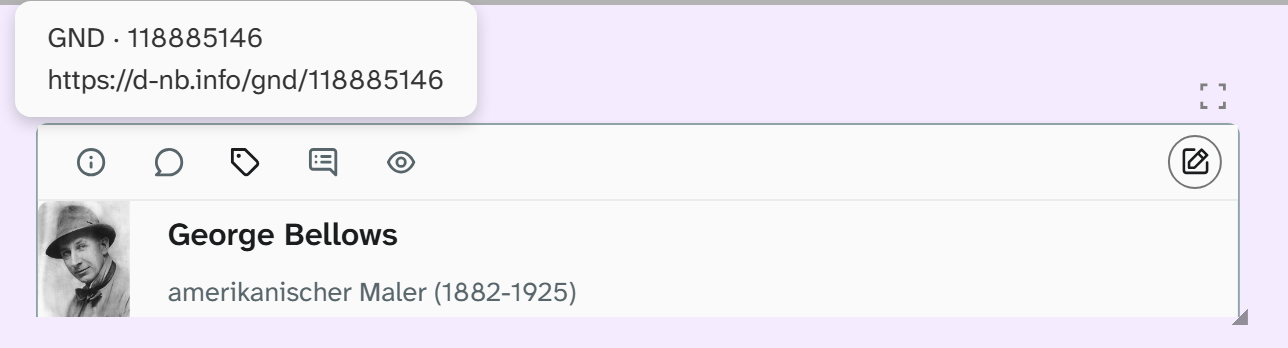
A controlled term from the authority data library : material, technique, genre, keyword, person, place. Behind the term is a record with an identifier, a source and a description, not just a piece of text.
Purpose
The same artist is spelled five different ways in five records. An authority record is an unambiguous identifier with a preferred name form. If you link it, you find all objects by this artist, no matter how the name would be written in free text. And exports such as LIDO get the identifier they expect for actors, places and terms.
Input
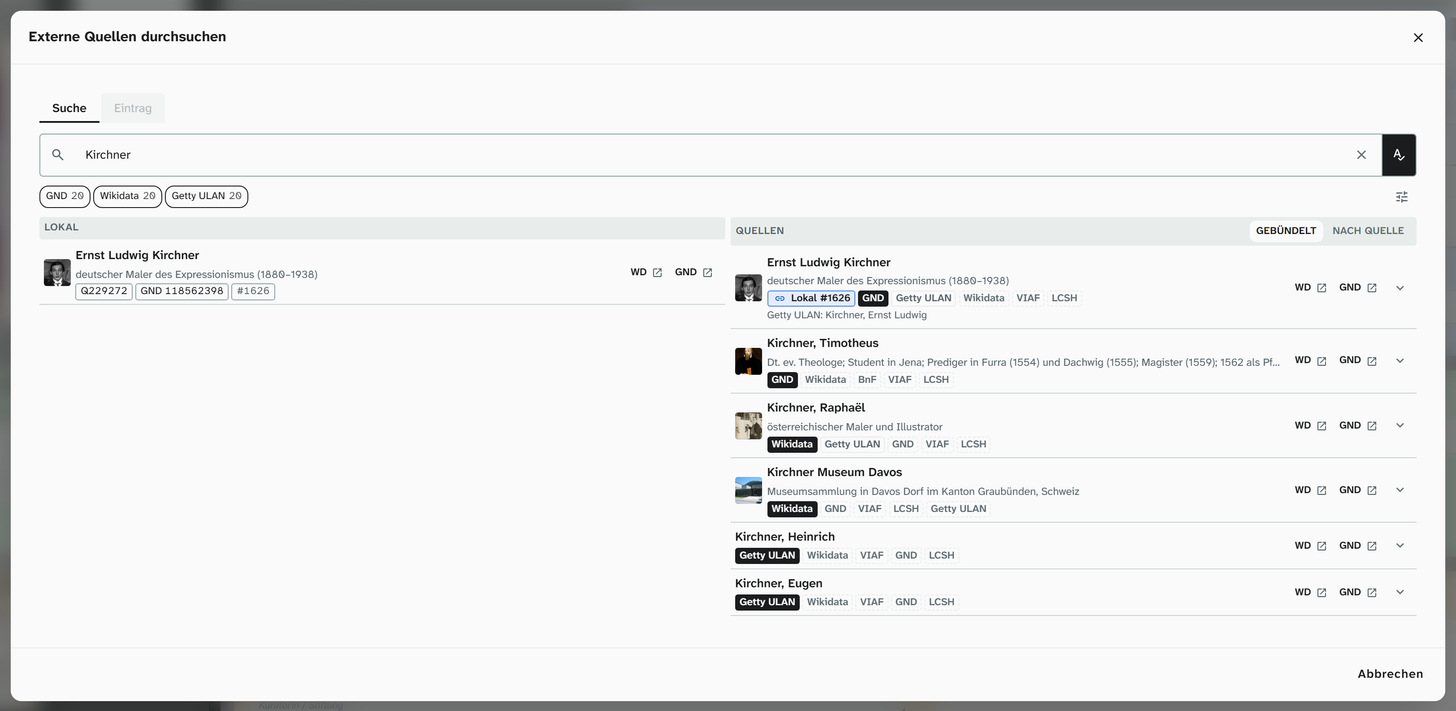
Type in the field. The search runs against your own library and against the sources set up for this field, for example GND and Wikidata. Moliri knows more than 20 such sources. Take over a hit: it is created as an entry in the library and is then available for all further objects.
After that, the field shows the name form and a link to the source. Whether you may edit the record in the field is decided by the administration; terms from an external source are usually locked so that they do not quietly drift away from it. The remark can always be written.
On the Entry tab of an assigned record, Sync with source fetches the current state from the source. What the sync takes over and what it reports is described under Sync with the source .
Fields that inherit from the authority record
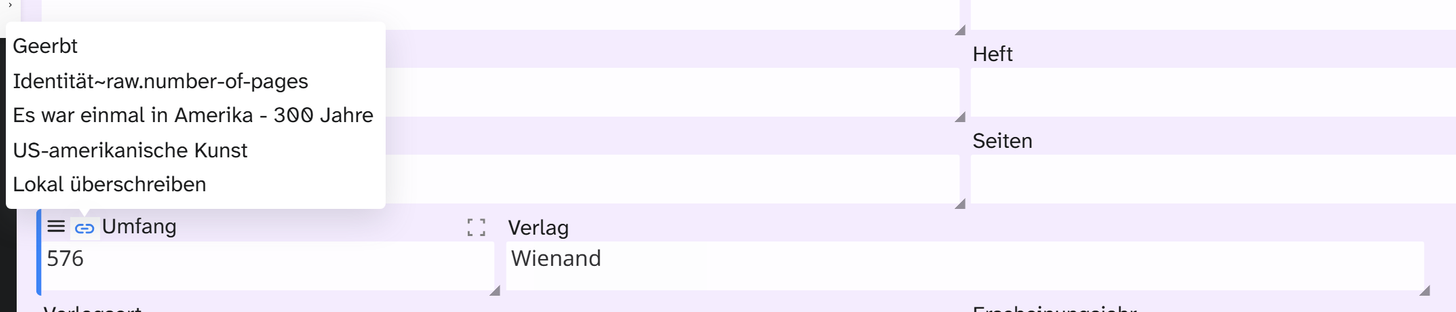
Another field on the object can take over a detail from this field’s authority record, for example title, year of publication or publisher from a bibliographic reference. An empty field then shows the record’s value and follows it when the sync changes the record. A value of your own stays untouched. Which fields inherit is decided by the administration (see Fields ).
An inherited value carries a blue link icon next to the field label. Its tooltip says Inherited and names the detail in the record and the record itself.
| Action | Effect |
|---|---|
| Enter a value of your own | The value detaches from the record and stays as you entered it |
| Click the link icon (Override locally) | The value stays but no longer follows the record (Value overridden locally) |
| Click Inherit again on a field with a value of your own | Replaces your own value with the record’s (Value inherited again). If the two differ, Moliri asks first |
Inherit again appears as soon as the record has a value for this field. If your own value differs, the icon is always there, otherwise when you hover; its tooltip gives the record’s value (Authority record: …). Both need write permission on the field.
Inherited links
An authority data field can create the persons of a reference, for example authors, editors and translators, as links on the object. Moliri looks up each person by their GND number in the reference or, where it is missing, through the GND name search at lobid.org. A link is only made if there is exactly one hit.
In the link area an inherited link carries the blue icon with the tooltip Inherited from …, and next to it the name form as it appears in the reference: in quotation marks or, where the link type keeps it as a detail, under name form as printed. If you remove an inherited link, it is only hidden. The eye icon shows the removed ones (Show removed inherited links), and Inherit again brings one back. Links of your own are not affected by inheritance.

When the authority data field is saved, the message says what inheritance has done:
| Message | Meaning |
|---|---|
| n inherited fields updated | Fields that inherit from the record have the new value |
| n inherited links updated | Persons were linked, changed or removed |
| n fields filled from inherited links | Fields tied to a link type were filled |
| Warnings on inherited links: n | A rule of the link type was triggered: type hidden, maximum number per object reached, vocabulary does not match or a required additional field is missing |
| Inherited links skipped, object is in no project: n | The object is in no project, so nothing was linked |
| Names without a GND match, not linked: n | The GND found no unambiguous match for these names |
| n names are being looked up in the background | When saving, Moliri queries at most three names at lobid.org; a background job looks up the rest |
| n names not looked up (lobid unreachable), inherited links kept | lobid.org did not respond. The existing inherited links remain |
The same inheritance runs when a value gets into the field by another route: when undoing in the history, when matching under Resolve references , when copying an object, when merging authority records and with New from reference in the literature library. The message from New from reference gives the same notes.
What is stored
A reference to the entry in the library, neither the name form nor the GND identifier. A correction in the library takes effect on every object.
| Action | Behaviour |
|---|---|
| Full-text search, filter | Via the subfields, for example the name form |
| Sorting | By name form |
| Grouping | Yes. The most reliable grouping for actors, because it knows no spelling variants |
| Bulk edit | Replace and clear the reference |
| Excel import | Names and identifiers in the spreadsheet are not references. They are parked and matched via Resolve references , with suggestions from the sources. A person confirms |
Display and export
| Formatting | Preset in | Result |
|---|---|---|
| Raw value | Export | Several identifiers and details in a row |
| Label only | Gallery, table, kanban | Albrecht Dürer |
| Label with source | nowhere | Albrecht Dürer (GND …) with the GND identifier, without GND with the Wikidata identifier |
Individual details such as the GND or Wikidata identifier are separate columns as subfields in the Excel export . In templates the label is usually what is wanted, see Output formatters in templates .
Setup
Which sources the search offers and whether records may be edited in the field are set by the administration. See Configuring authority records .